
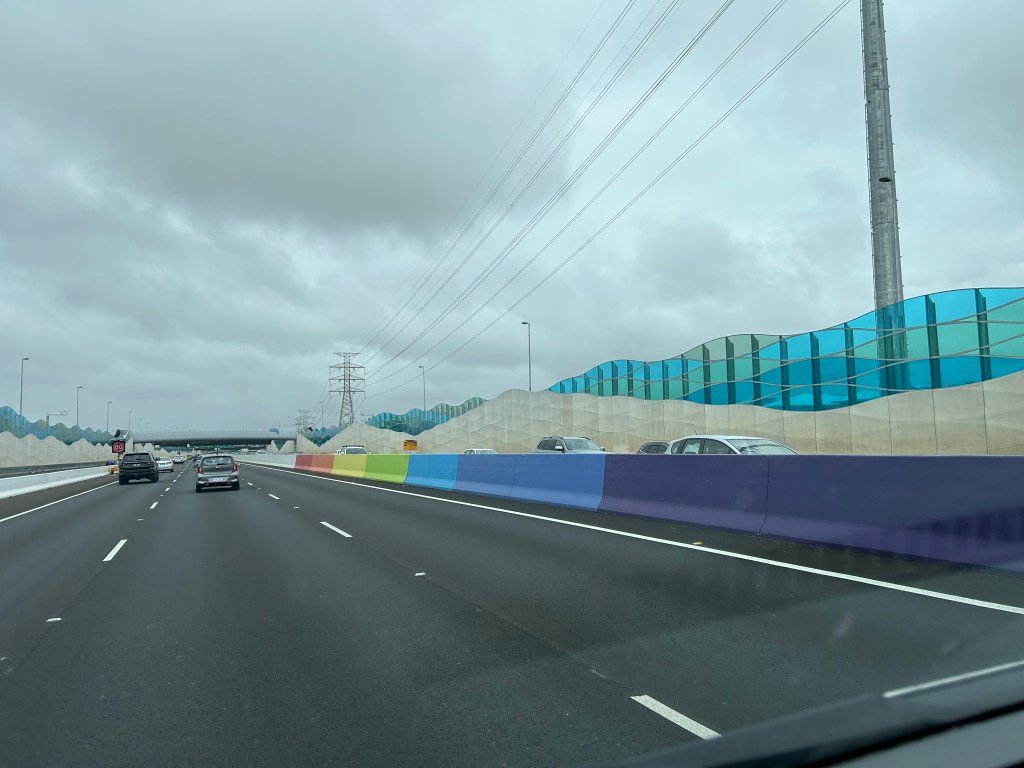
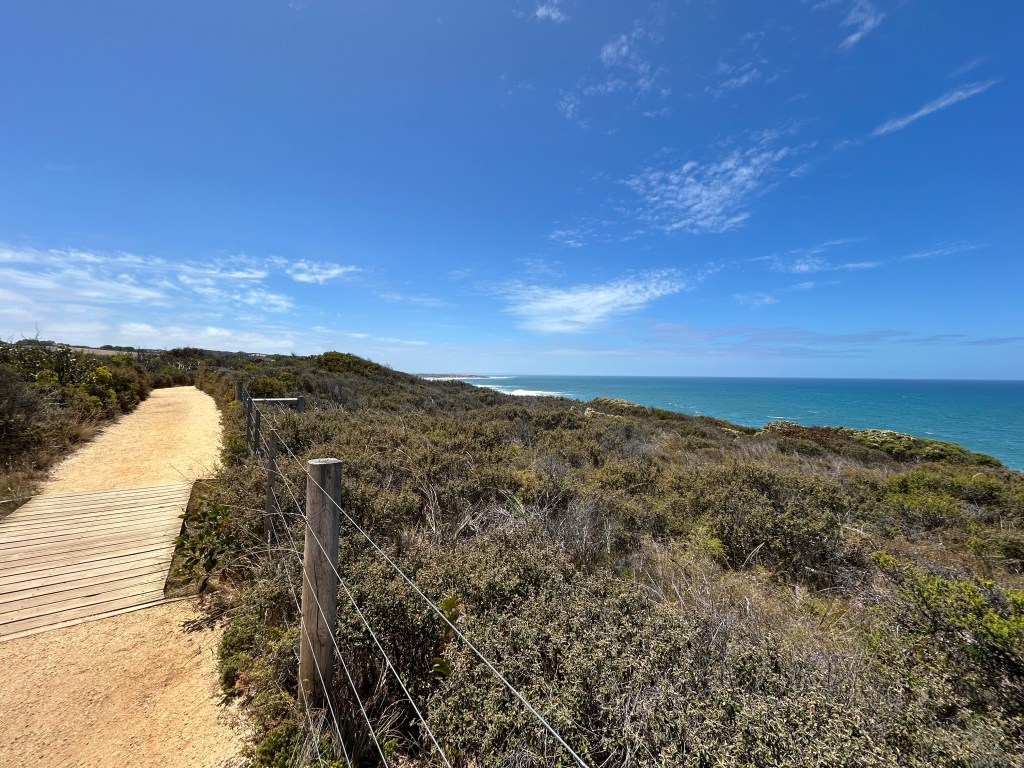
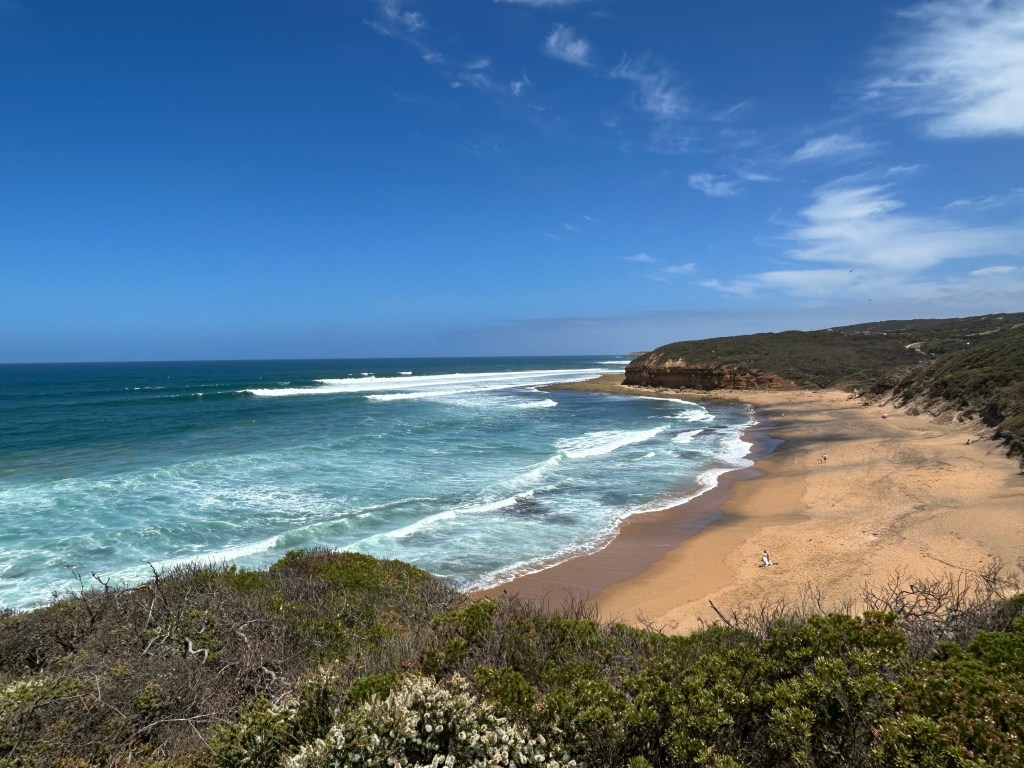
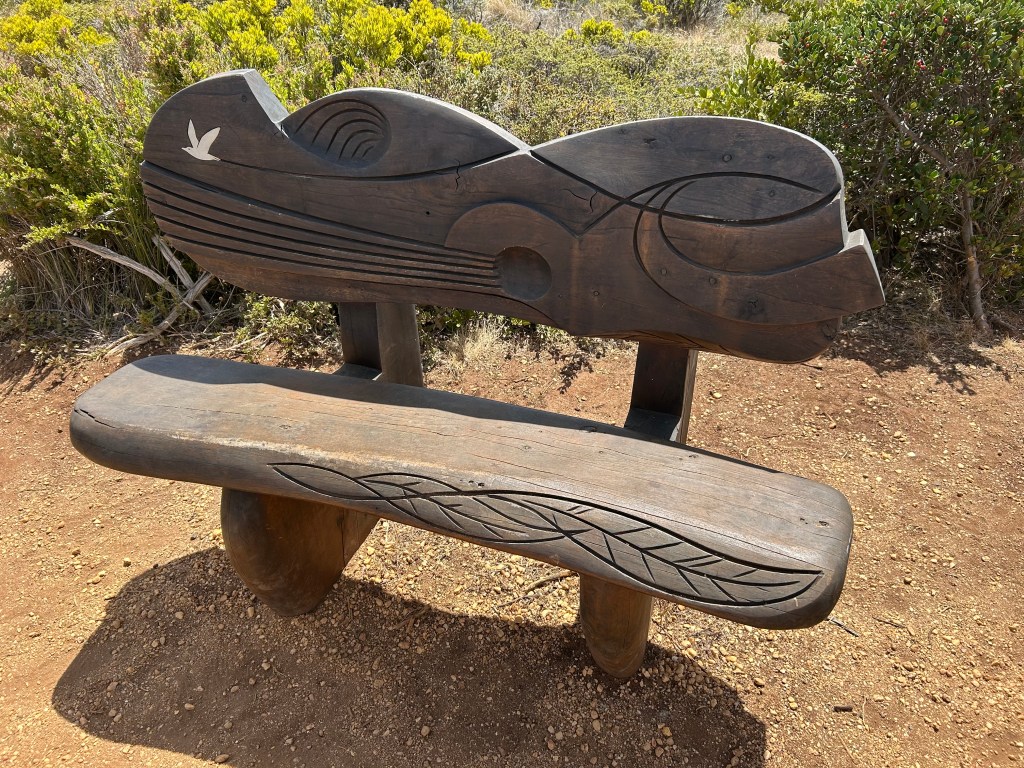
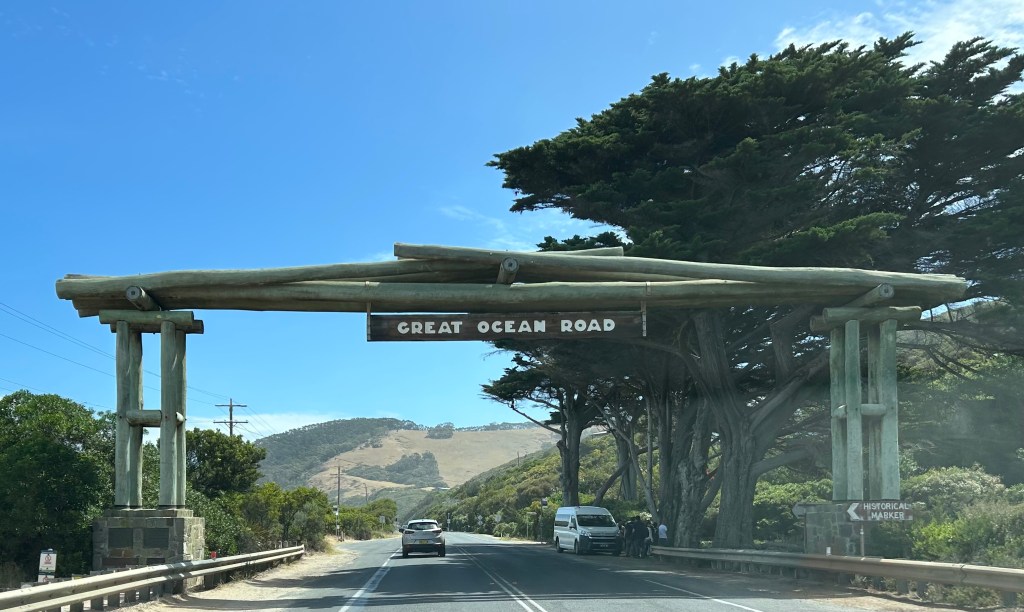
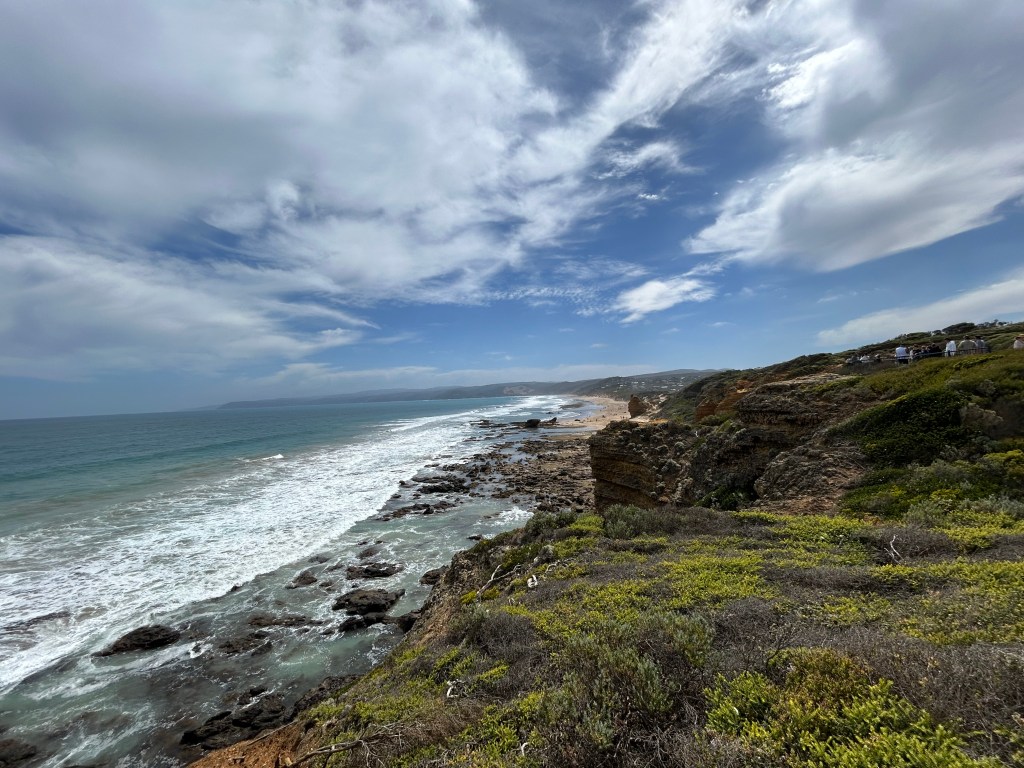
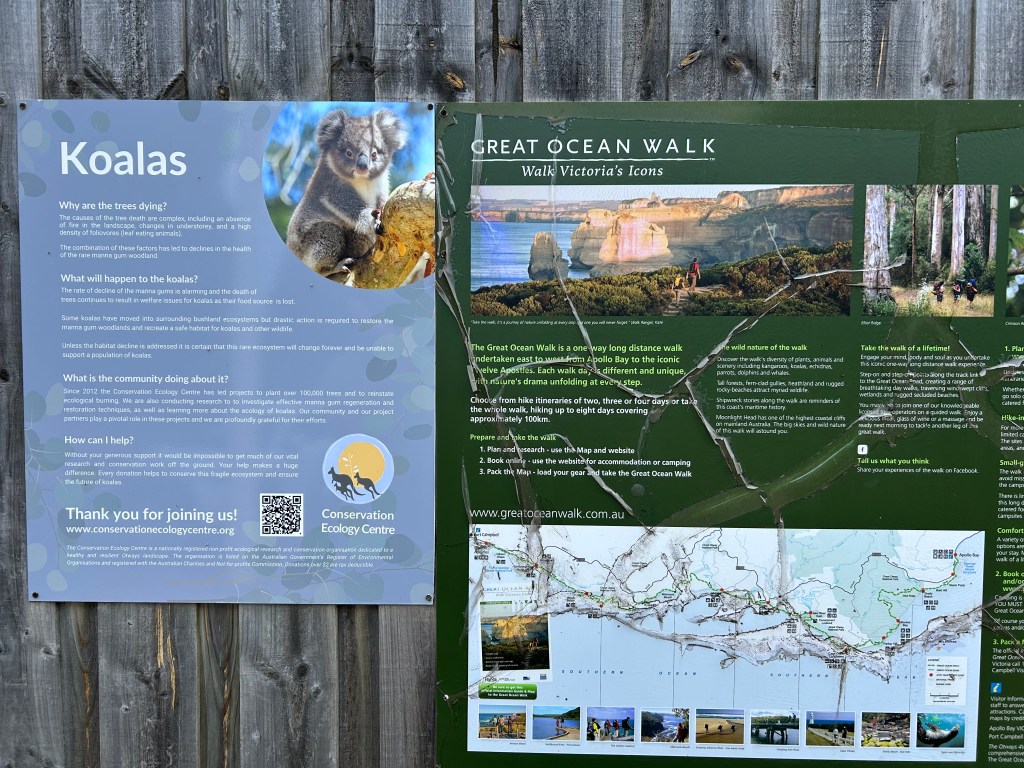
Leaving Melbourne put us on the final leg toward the South Australia Wine region. One of the bucket list routes for many a traveller is the Great Ocean Road (GOR). Being Sunday of the Australia Day long weekend, and with no campsites booked, we decided to enjoy the view until we needed to decide. We stopped at a few roadside lookouts and took a walk from one lookout to another along the Great Ocean Walk (GOW) trailway. This parking lot, Winkipop, had some good stickers on its name sign, a surf beach, and an artfully painted loo.


Another stop that was recommended was Split Point Lighthouse at the Aireys Inlet Volcano site.

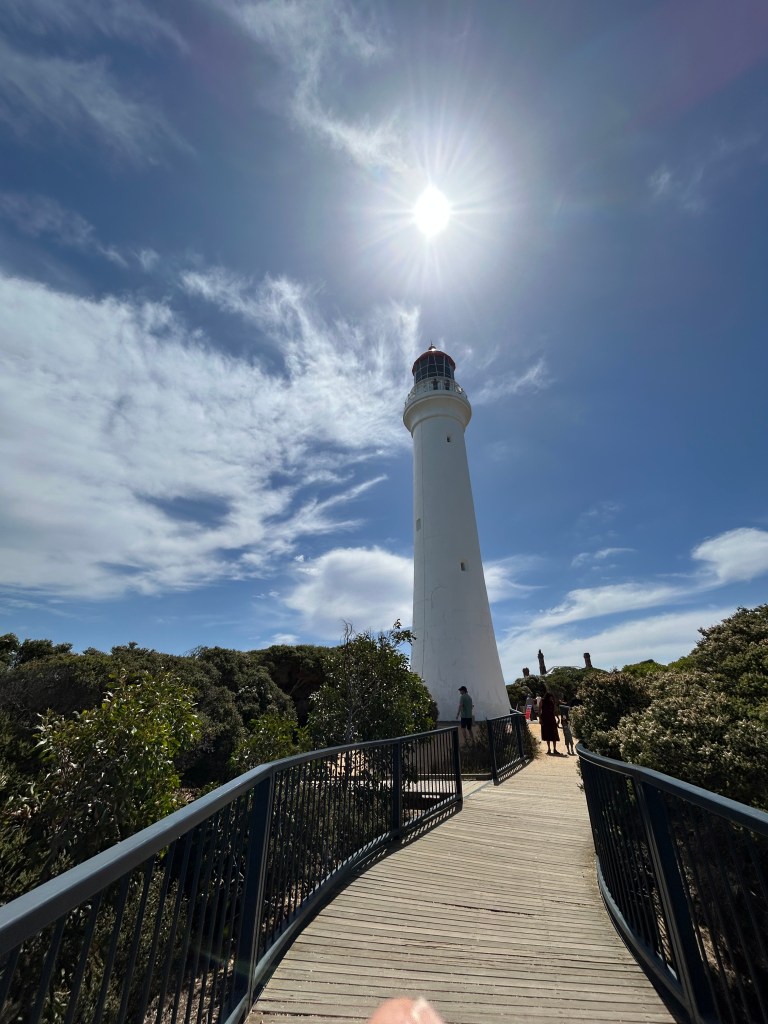
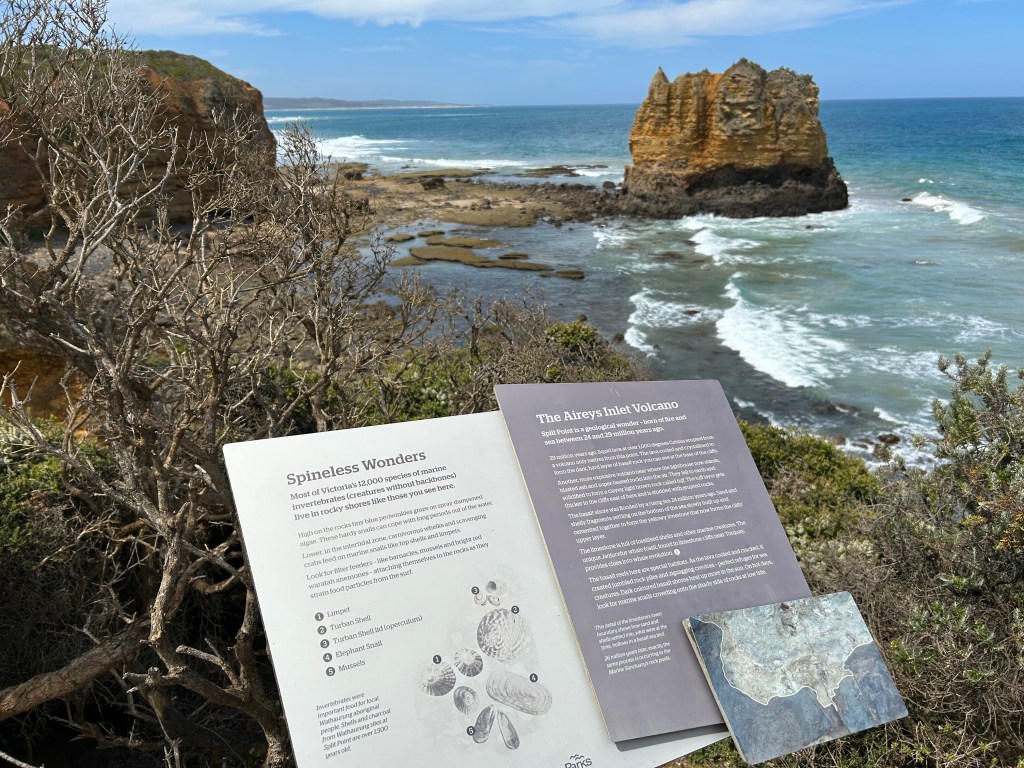
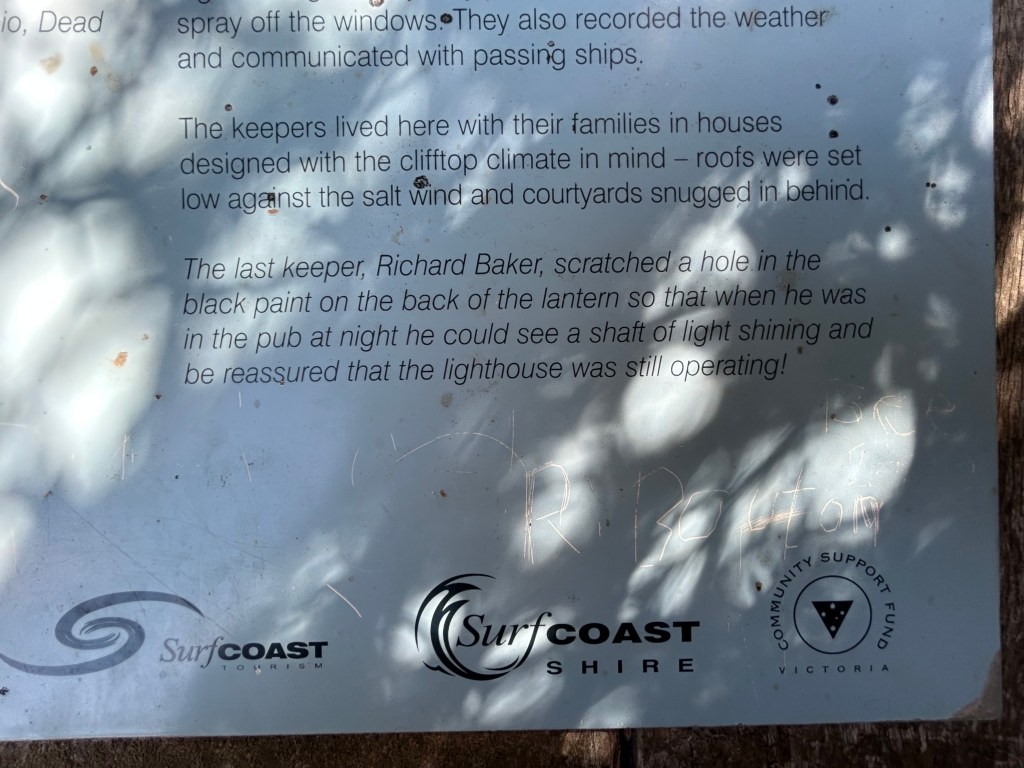
I loved this interpretive tidbit. “The last keeper, Richard Baker, scratched a hole in the black paint on the back of the lantern so that when he was in the pub at night, he could see a shaft of light shining and be reassured that the lighthouse was still operating.”
Even though it was a driving day we managed over 15000 steps!!
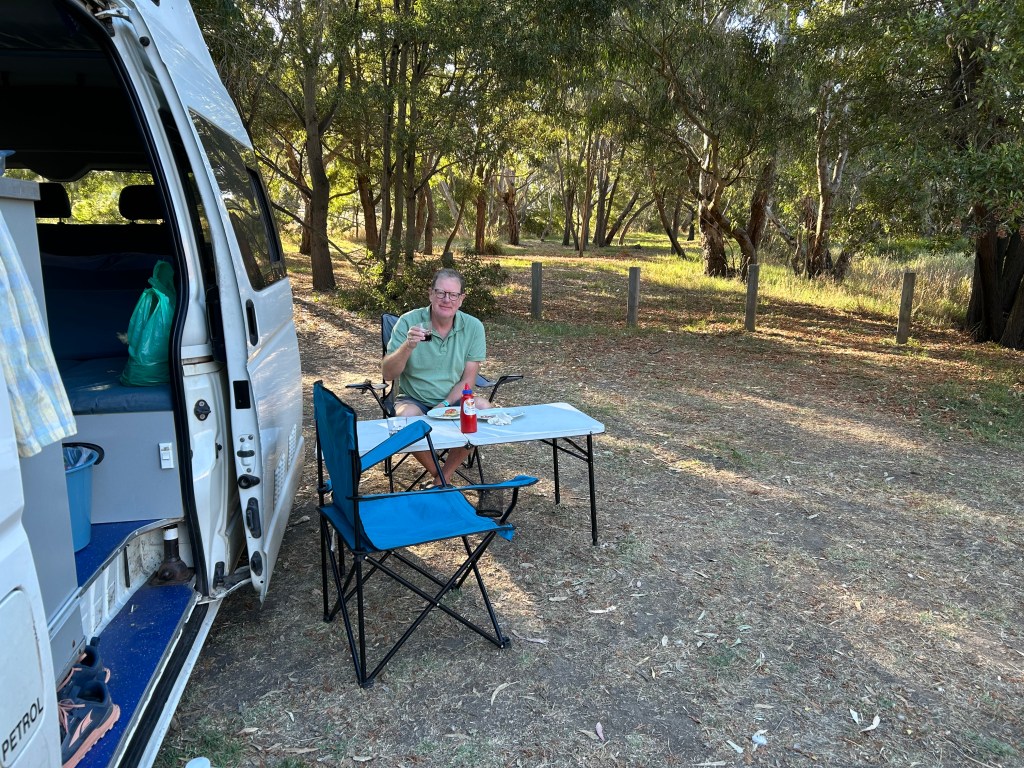
The shoreline from Melbourne was busy! Families camping and tour busses spewing international onlookers everywhere. We knew all camping areas were full to overflowing for one last night and we would not be included in the mosh pit. An app, Campermate, that we use to find camping, toilets, gas and propane was useful but near the ocean there are no rest stops or boat ramp/marinas with overnight stays allowed. When we arrived in Lorne we pulled into the tourist office. The recommendation was to go inland to the Prince’s Highway and head to a park at Winchelsea that allowed overnights for free. Ok! The drive inland was completely uphill and about 35 minutes from the coast. This route had signs all over it that it would be closed for the famous Cadel Evans Great Ocean Road Race, a very big bike race happening in a few days. We would be well clear of that by then. The info guy said when you get to the highway, turn left, then turn right at the first turn after the bridge. Who needs google??? We did and found a lovely spot in a bit of shade by the Barwon River. Taking a walk along the river revealed where the local Cockatoos party and camp overnight!
We noticed cockatoos gathering along the waterfront (of course, that’s where all the best campsites are) before dusk in a few other stops and, as in other sites, the cacophony of hundreds of these noisy birds was deafening. Arriving back at our campervan we were just in time to hear and see a train pass overhead on a trestle coated in graffiti that was still active. We don’t have active train trestles at home!! All the birds eventually settled in for sleep once the sun was down and we heard no trains overnight until about 4:30 the next morning. Short lived passenger train with about 6 cars. It wasn’t the train that woke me up, it was the thunder and lightning. You get what you pay for so the price was right!


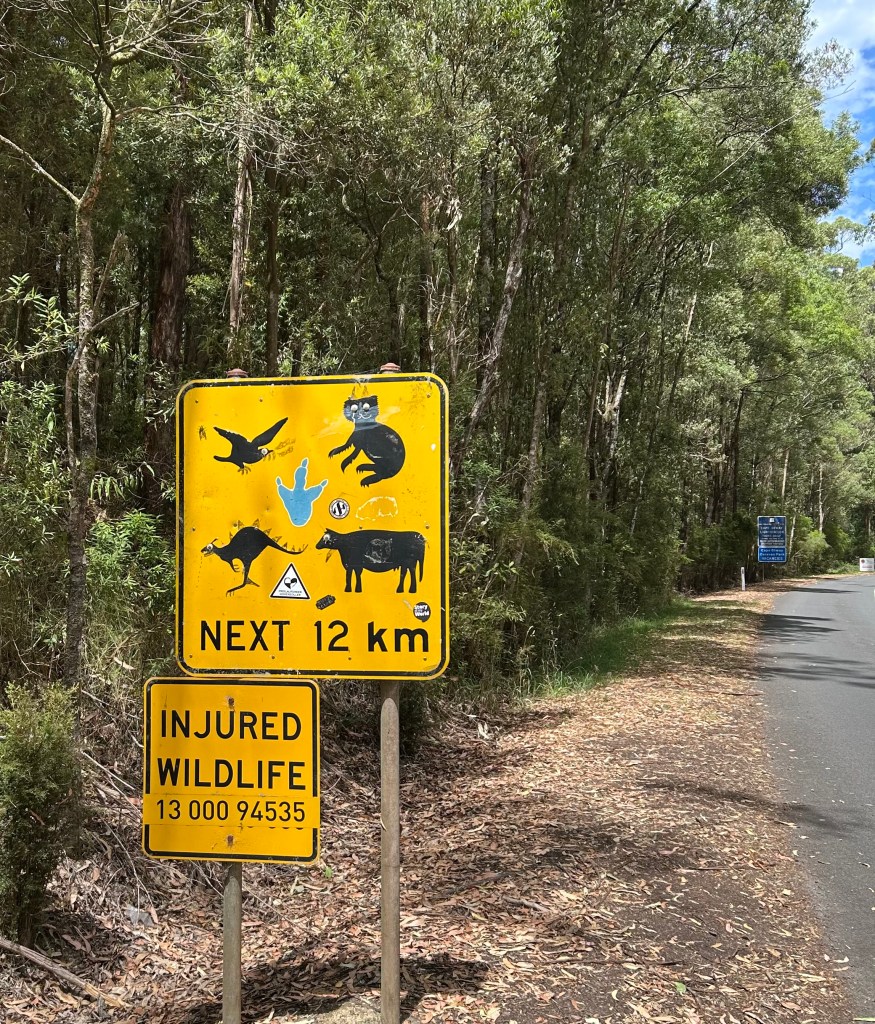
And the drive to and from the GOR through the jungles of huge ferns, eucalyptus and cattle fields was beautiful. The clouds disappeared and we continued. We needed gas and decided we had enough to get to a small inland community of Laver’s Hill past Cape Otway National Park. On our way to the cape through thick coastal underbrush and forest, we passed a young man with jeans, a small canvas rucksack and wondered out loud about his walk. We drove to the lighthouse at the end of the cape and were greeted with a gatehouse charging $22 each and weren’t really that committed. This lighthouse was a very important navigation aid as it helped sailors bypass the famously shipwreck strewn coast. We decided to walk the GOW to another lookout that showed a glimpse of the lighthouse and the ocean. But the best part was leaving and picking up said young man who was hitching a ride to the main road and heading in the opposite direction from us. He hopped in and we learned he was a Texan, about 21, worked in retail, saved up to travel and bought a one-way ticket to Australia with a tourist work visa in case he ran out of money or didn’t want to go home yet. This was less than one week after a new president came to power and he wasn’t ready to face the aftermath. He hadn’t seen a koala yet and we had stopped along the way and noticed some in the forest on our way in. Within a few steps we saw at least four and then, clearly visible, was a mum and Joey (baby). Elated in our contribution to find his first Koala siting, we deposited our hitchhiker at the main road with two banana and an orange in his belly. He had walked from Warrnambool to Cape Otway a distance of about 150 Km’s. He was tired of walking.

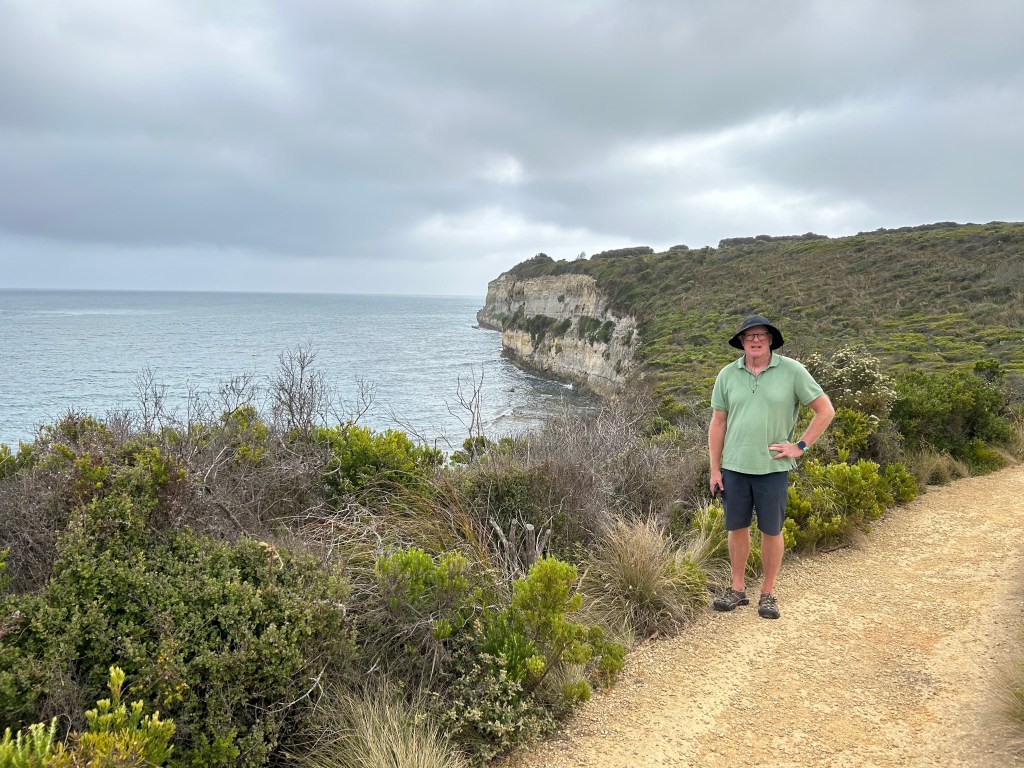
It wouldn’t be an Al & Deb road trip without some kind of absent minded glitch. We forgot to stop for gas at Laver’s hill and by the time we realized our folly, we were headed for Port Campbell, another 30 k down the road. Nervously glancing at the gas guage, we passed the crazy traffic at the most famous tourist stop along the GOR, the 12 Apostles, and limped to the petrol station with about 1 litre left in the tank. Whew! We decided to stay at one of two camper parks that had a laundry, showers, and beach. Luxury! When checking in we mentioned missing the 12 and she said to go at sunrise as there are no tourists until 9 am and then it becomes a mosh pit until after sunset. All chores done; we headed up the GOW to the headland to see one of the views our hitchhiker would have passed along his walk.



Early to bed, early to rise, means no coffee and tired driver. But WOW what a fantastic recommendation.

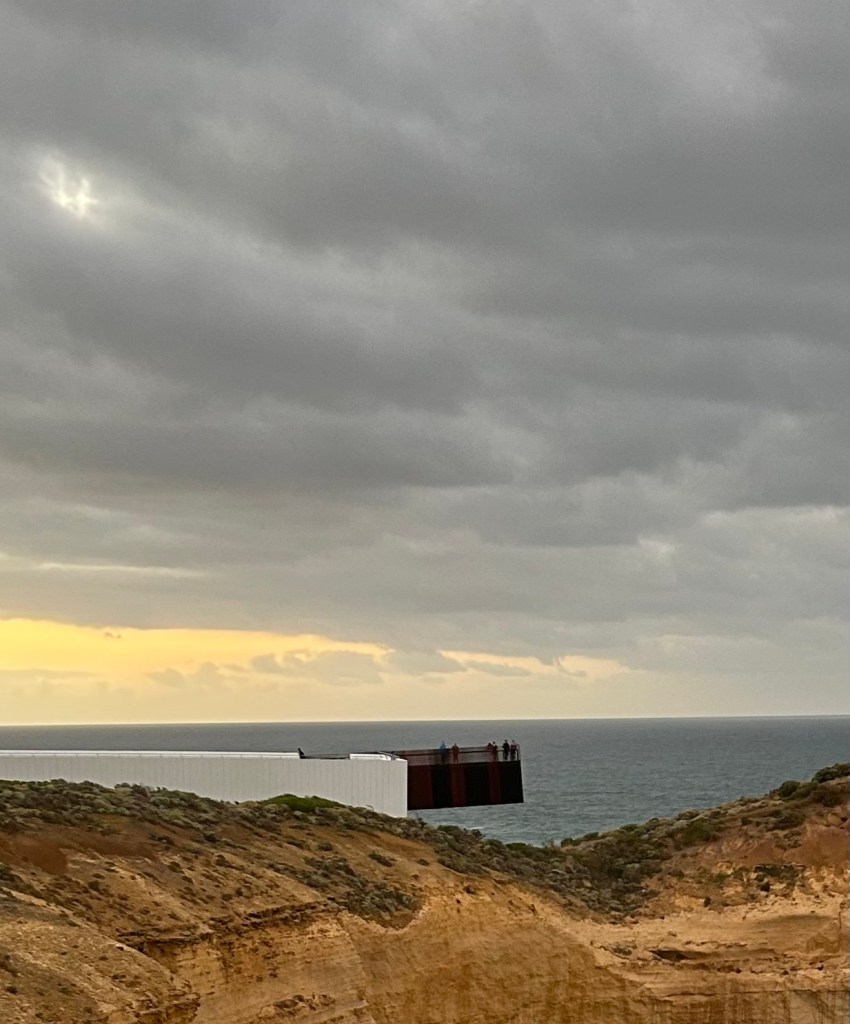
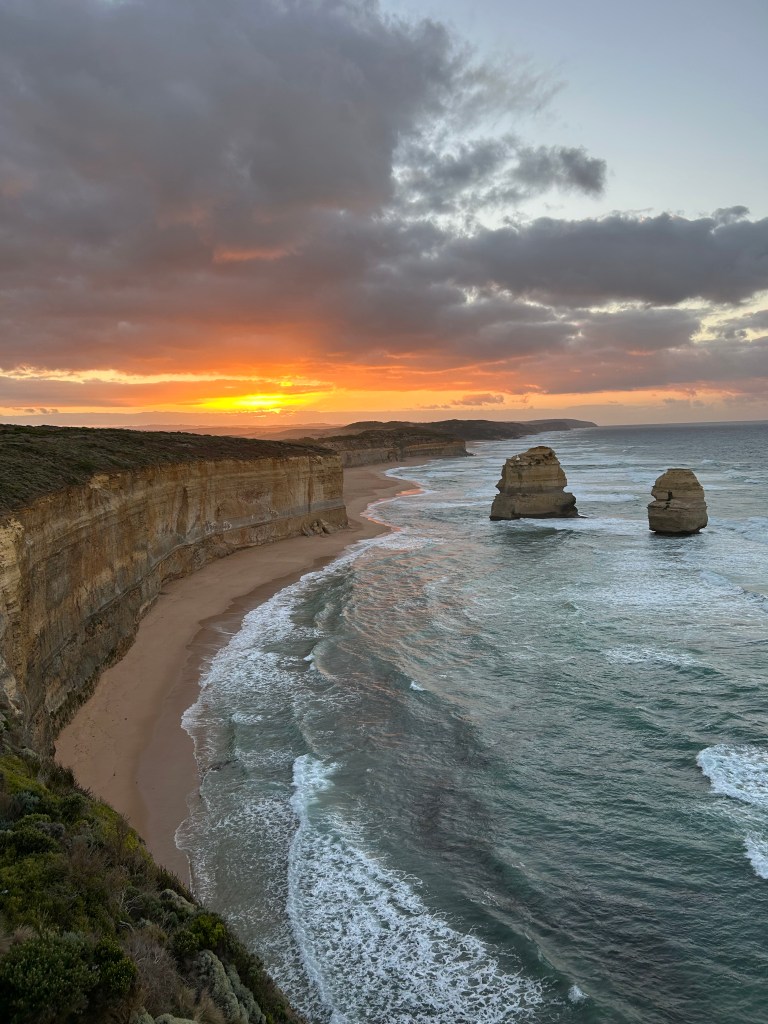


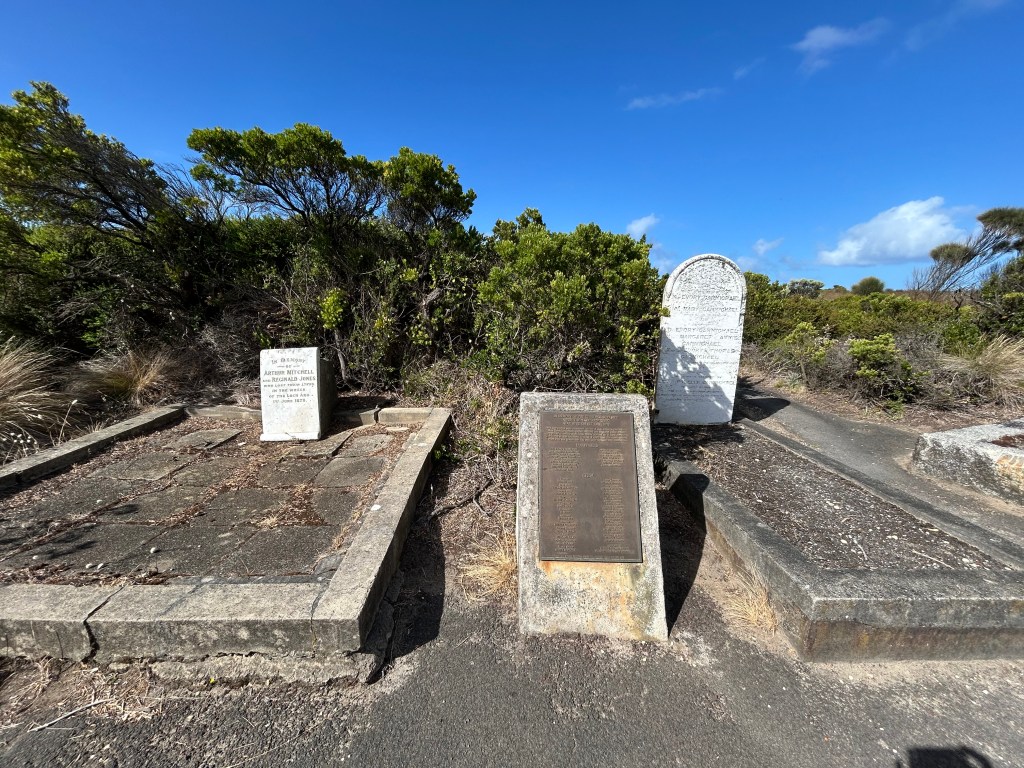
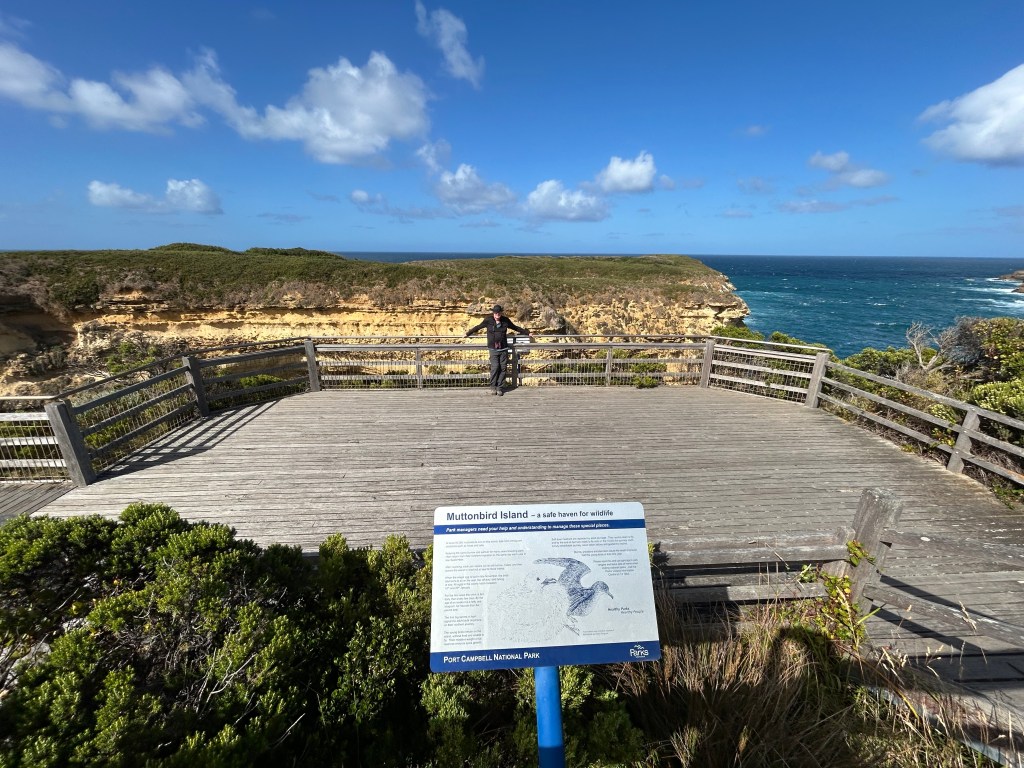
After viewing the 12 Apostles who are now, after erosion from tides and time, just 8 we made coffee and breakfast in the parking lot and headed to the next beautiful walk. The Loch Ard Gorge is the site of a shipwrecked Loch Ard. When she sunk, two survivors washed up in the gorge with all the ships debris. Four more were found and the rest, over 90 souls, washed away. A cemetery in honour of her and with some locals buried and remembered there made for a good story and beautiful walk. One of the peninsulas around the small gorge had a platform looking at Mutton Bird Island. The island has no introduced cats or foxes preying on the muttonbirds in this rare breeding area. This is important since these birds migrate from the Aleutian Islands in the very northern part of the Northern hemisphere. 50000, kilometers!! They are able to catch the wind and cover 600 kilometers a day!! We don’t even do that in a car without feeling the need to stop a few times!!!



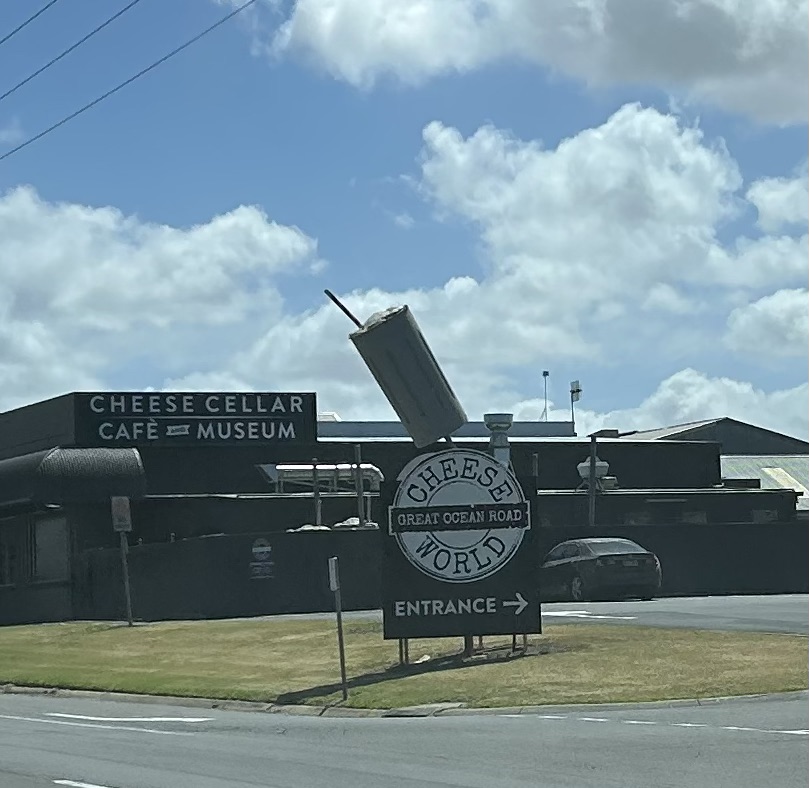
Discussing our next stage of the trip we considered which route to take to the Coonawarra. Travelling along the coastal highways had been great and that was our aim – see the coast while heading west. As we travelled through from the state of Victoria to South Australia the level of moisture was evident. Had we travelled inland we may have come across some bush fires that would impede our progress. So coastal road was chosen and most of it was low rise eucalyptus, gigantic fern trees, Wattle bark trees and numerous shrubs we may never identify. Mixed in with that were mangrove lagoons and cattle and sheep ranches. A lot of dairy and an obvious cheese economy.


The road is good but bumpy. We bounced along due to a lack of shocks and springs plus loose steering made for a chaotic drive. Like driving a trampoline! Albert named the beast “The Lizard King”. When heat became a real factor the lumpy, aromatic seat-cushion-bed was anything but comfortable. Scaly paint and spongy steering. The microwave, early in the journey, showed its uselessness on a corner by ejecting the turntable plate within, smashing to a million pieces all over the floor. But Albert did his best with his feet after we cleaned most of that up. Speed limits were all over the map with multiple speed zones in one view. What to choose??
We arrived at our destination of Mount Gambier in the early afternoon with very little research before deciding to stay. Our research was simply that it was a 44-minute drive to the Coonawarra. What a gem!! This historic town is the gateway to the Limestone Coast, the region that has the Coonawarra, the Mt Benson appellation and borders the McLaren Vale, Barossa Valley and Langhorne Creek regions. This area boasts caves, waterfilled volcano craters and hiking along basalt and limestone crater ridges. In the center of Mount Gambier town was a garden cave that was beautified a century ago with a tropical garden that boasted cooler temperatures in the heart of summer heat.


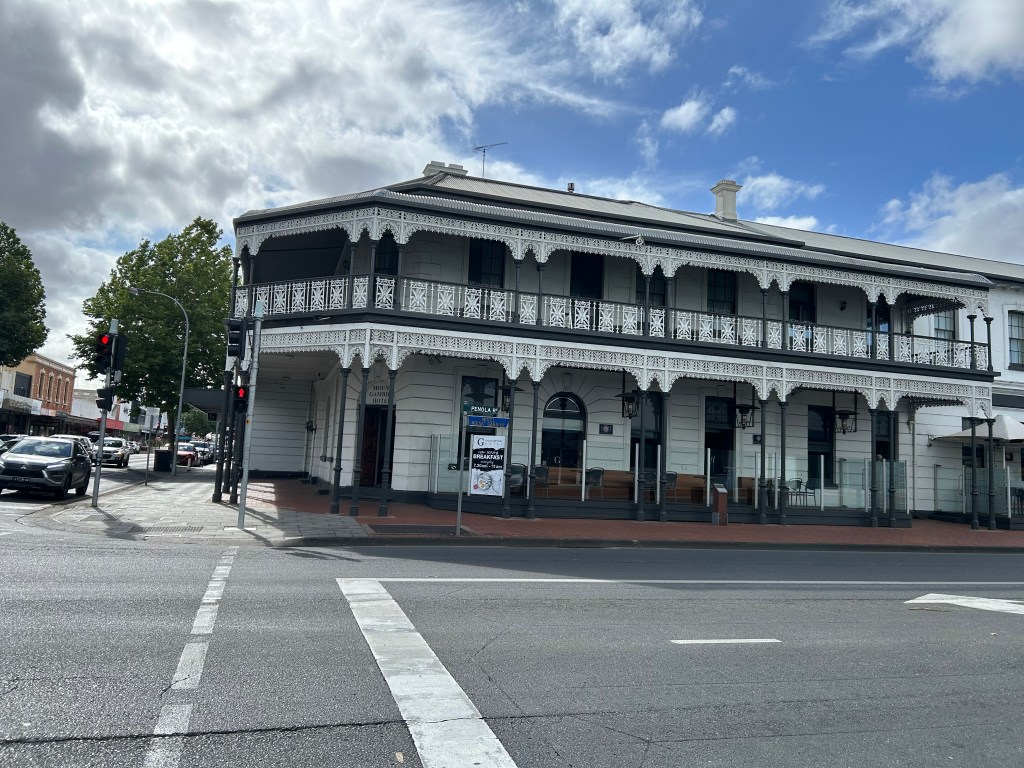
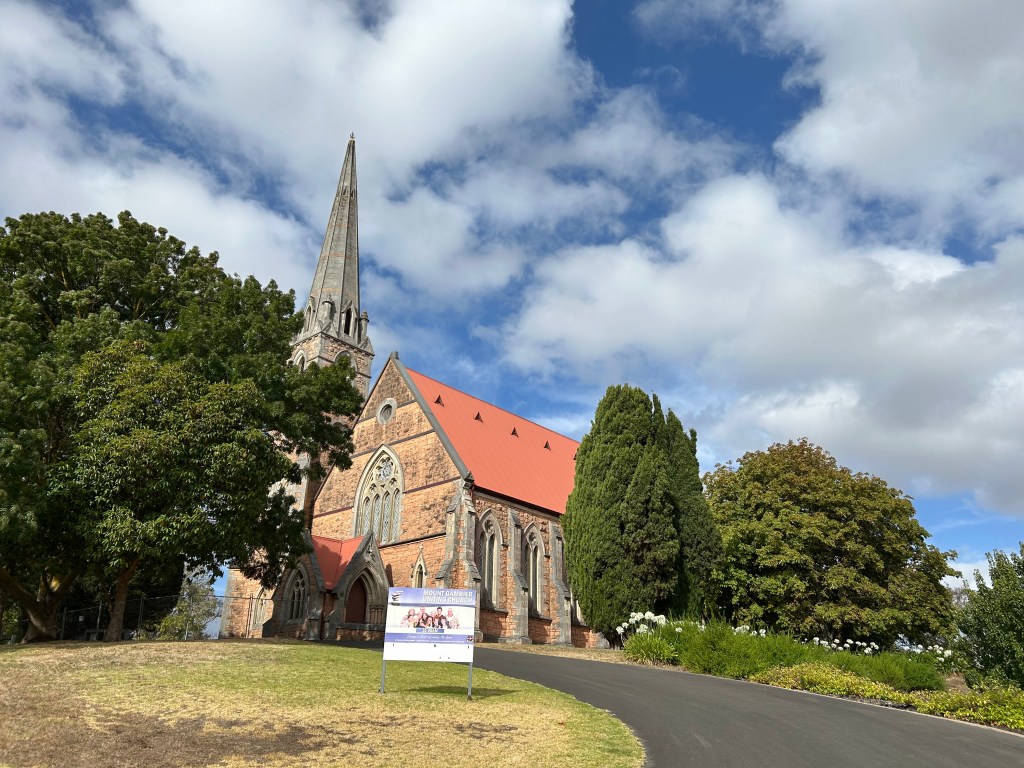
We chose a campground in the center of the historic town and walked around admiring the architecture of a past era. The catholic church was instrumental in assisting past governments with re-educating the last landowners whose historical evidence went back 30,000 years. So many similar injustices to our own Canadian story. We also marvelled at the old hotels in town with their wrought iron decorations very similar to the historic elite homes and businesses in New Orleans. We booked for two nights.

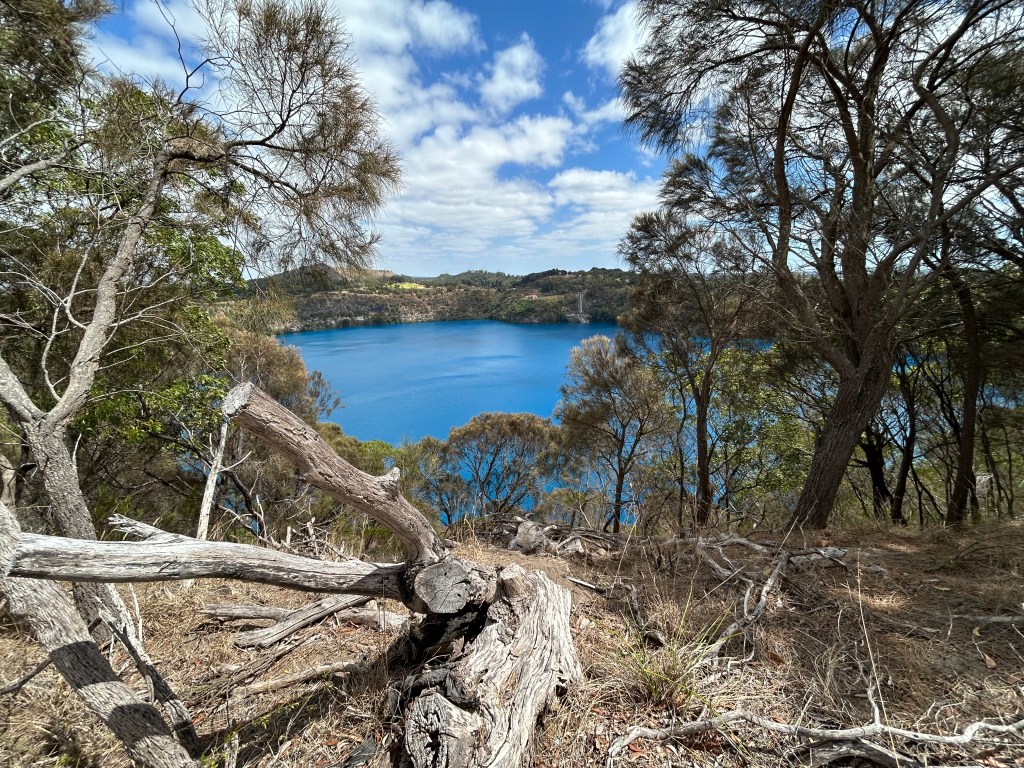
The next day was our foray into Coonawarra education. But before we headed into day drinking territory, we decided to go see the Blue Lake. From the outskirts of town and in the downtown core, there is a hill that rises up hiding any topography beyond it. One of the original surveyors of the area hiked up and was speechless in his description of the azure blue lake that was hidden from view in the dry grasslands and shrubbery that made up the majority of the area. We arrived to a parking lot along a ring road beside a stone wall and pavilion built in one day by all the town’s population of 2000 volunteers following WW1. Imagine what a community project in your neighborhood could accomplish today in one day! At this same small parking area was a lookout where another historic character had shown his equestrian prowess by leaping his mount off a cliff, onto a rocky outcrop and back up onto the roadway. He lived. So did the horse. The viewpoint gave a great view of the Blue Lake and her crater as well as two other extinct and water filled volcanos in the same park. In the distance another crater cone that was famous for its underwater cave exploring by scuba and snorkeling. Who knew?




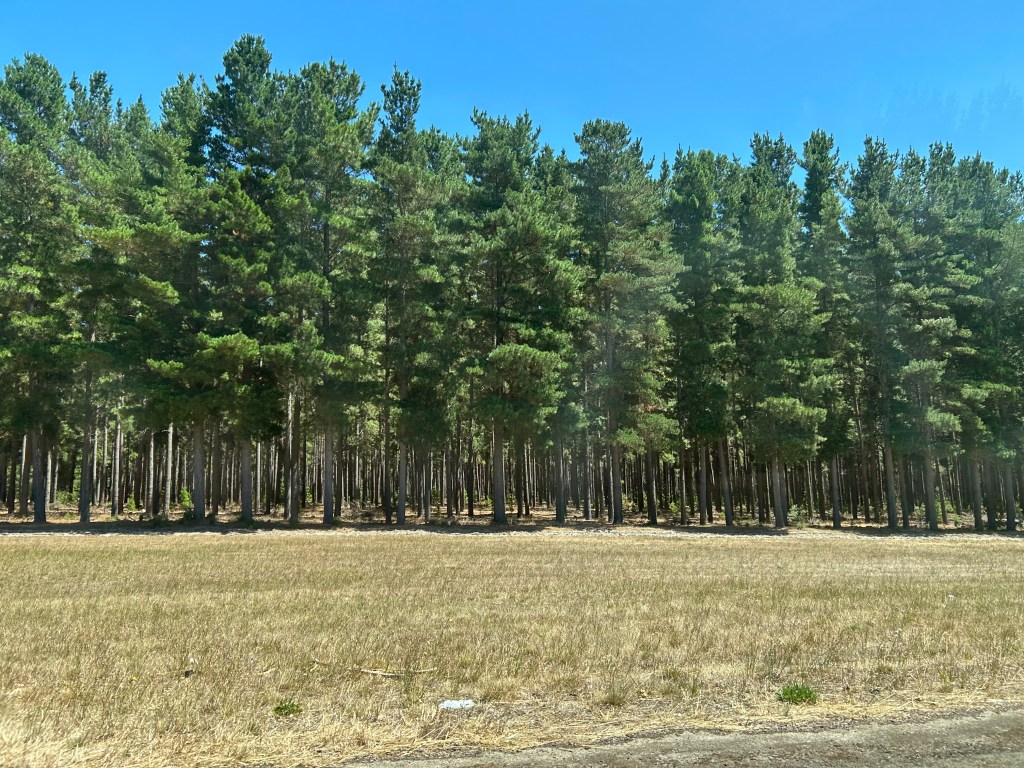
Our day in the Coonawarra started with the drive past vast woodlots of pine forest. These pine trees were an import from the USA. We saw similar pine forests in the town of Live Oak in Texas in 2019. They are quick growing and can be harvested in about 20 years for their softwood industry.
The Coonawarra is a strip of red soiled earth over limestone that is just 27 kilometers long by 2 kilometers wide. This red earth and limestone terroir is found in just a few regions in the world. Spain has its famous Terra Rossa as one example. Cabernet Sauvignon and Shiraz are the two main varietals, but we had some lovely blends of Cab Merlot as well. We stopped at Katnook first as this well recognized operation is available throughout the world. Katnook is the second largest vintner in the region. From there we asked where to go as we had only that day and a max of 3 wineries before our palates would say “STOP!” This area not only boasts the characteristics from the red earth, but we were also told that the somewhat cooler temperatures benefited the grapes. The next two were Brand’s Laira and Zema wines. Brands’s Laira had some of the oldest vines in the area dating back over 130 years. This farm had been a sheep operation named after the owners ship from his last career as captain on the ancient ship Laira. Over the years it changed hands and morphed into a respectable wine operation with the incoming Wynns, Riddochs and others who contributed to the game. Good wines but only for members, local bottle shops and cellar door (tasting room) sales. Zema was recommended because they have a sparkling Merlot that was merit worthy. We headed there in the camper even though the local wine trail joined these two vineyards and a few others in a walkable 5 kilometer loop. The sparkling was very deep red tapas wine that tasted like it could stand up to a plate of sardines or fried eggplant with a roasted tomato and olive topping. Their whites were good, but the reds were very good. Apparently Zema has a rep in Vancouver so we will keep and eye out.


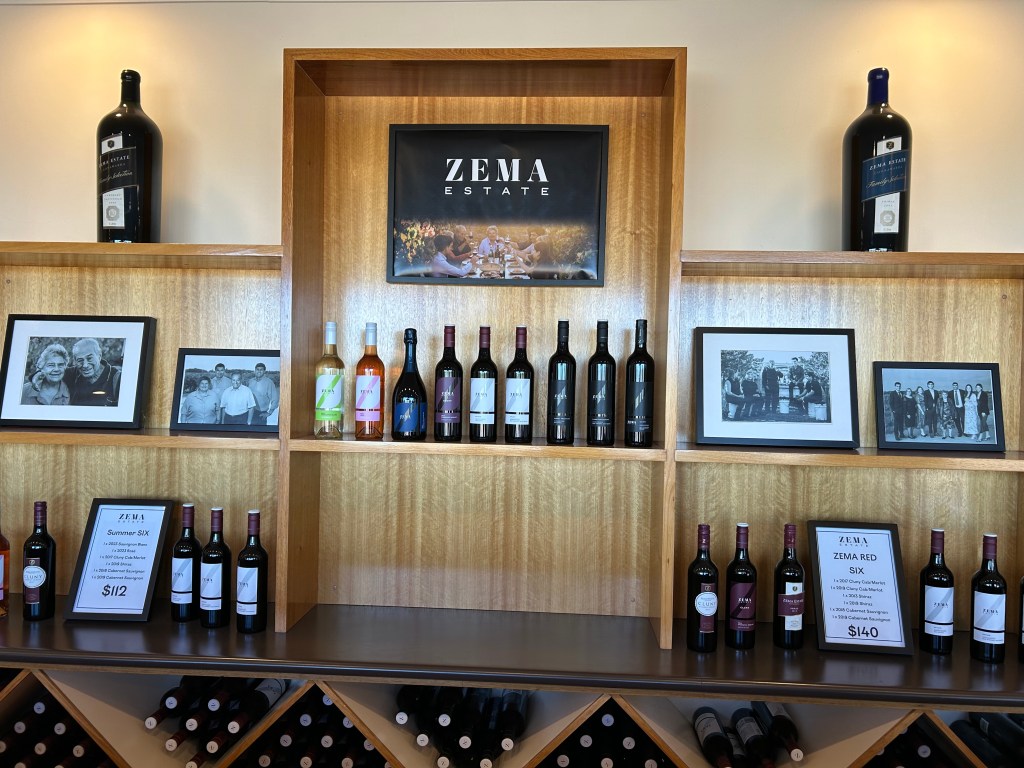

Knowing we were going to be unable to purchase a few favourites we managed to leave the Coonawarra with one lonely bottle of Cabernet Merlot. We still had McLaren Vale and Barossa Valley and only 7 more nights to sip sip sip!!
After our second night in Mount Gambier, we headed along the Southern Ports highway to Kingston. We were told that the town of Robe was beautiful, and we should spend some time there. Tossing up the idea of staying or continuing along another 30 minutes to Kingston was decided when we got to Robe but we stopped in to have a look. Robe is a quaint artsy community built on a point of land with an enormous reef slowing the waves from the Southern Ocean. It boasts the longest jetty South Australia. And it was long. We drove through the street full of tourist shops, galleries and coffee shops and decided we weren’t into browsing shops. However we noted a local food vender that boasted “the best scallop pie around” so we shared one for lunch and were not disappointed. At the end of the street, we found ourselves on a rolling scenic drive through sand dunes and sculpted bays.
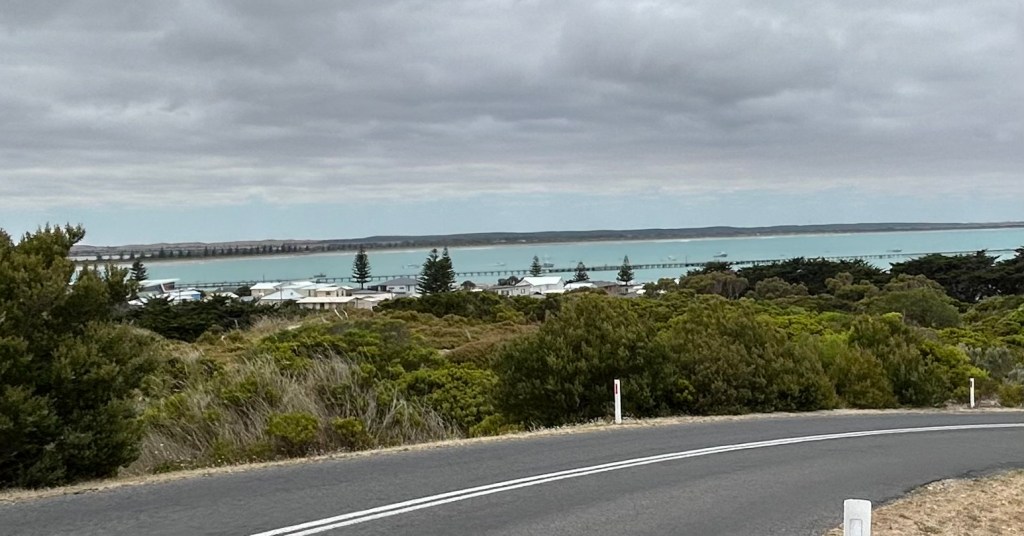
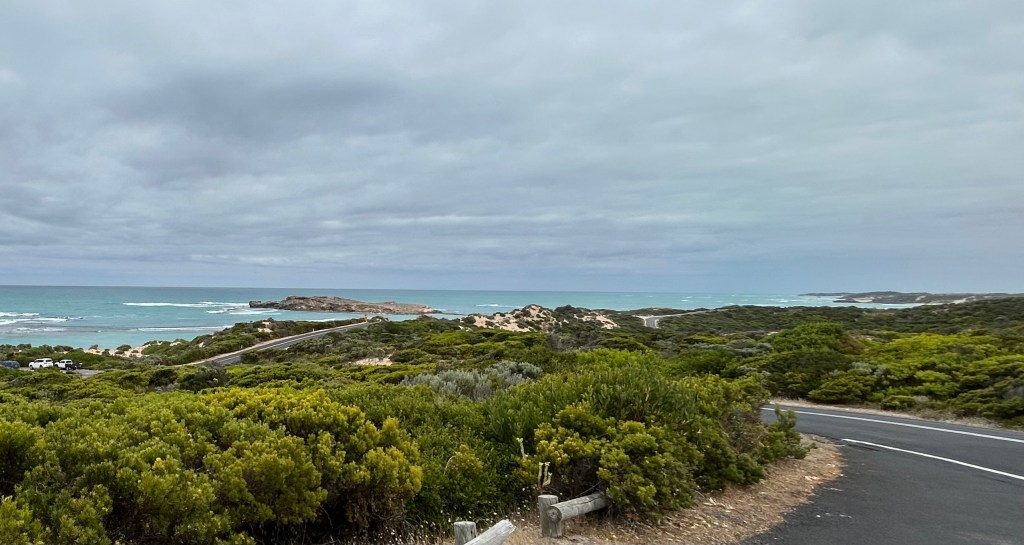
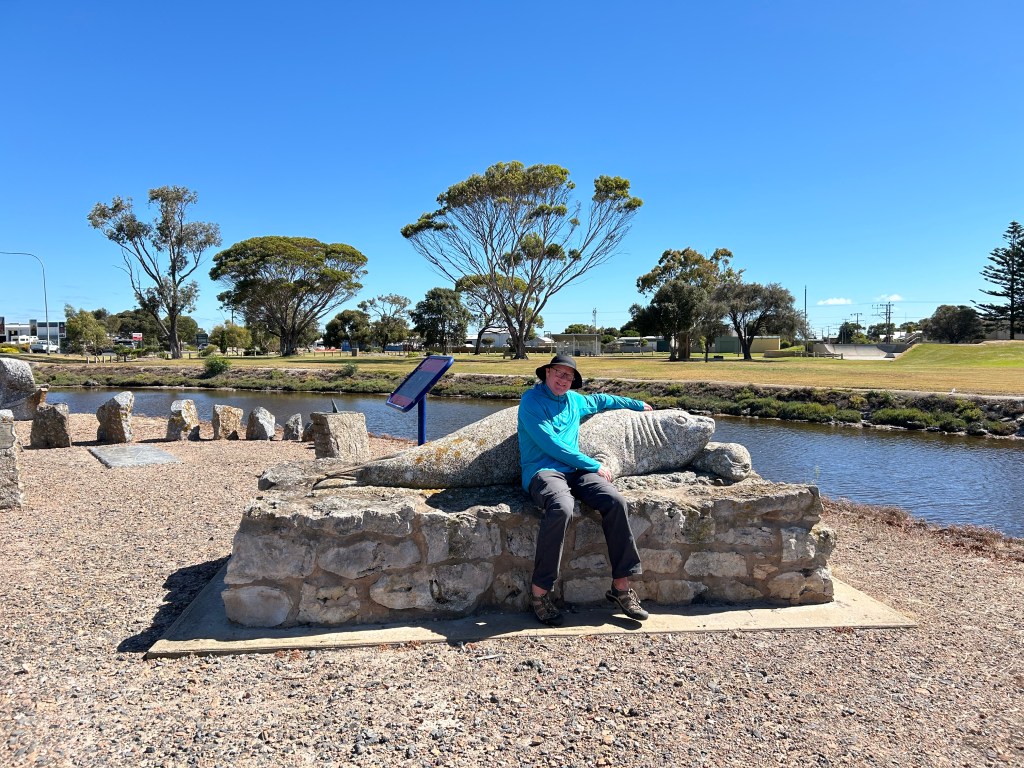
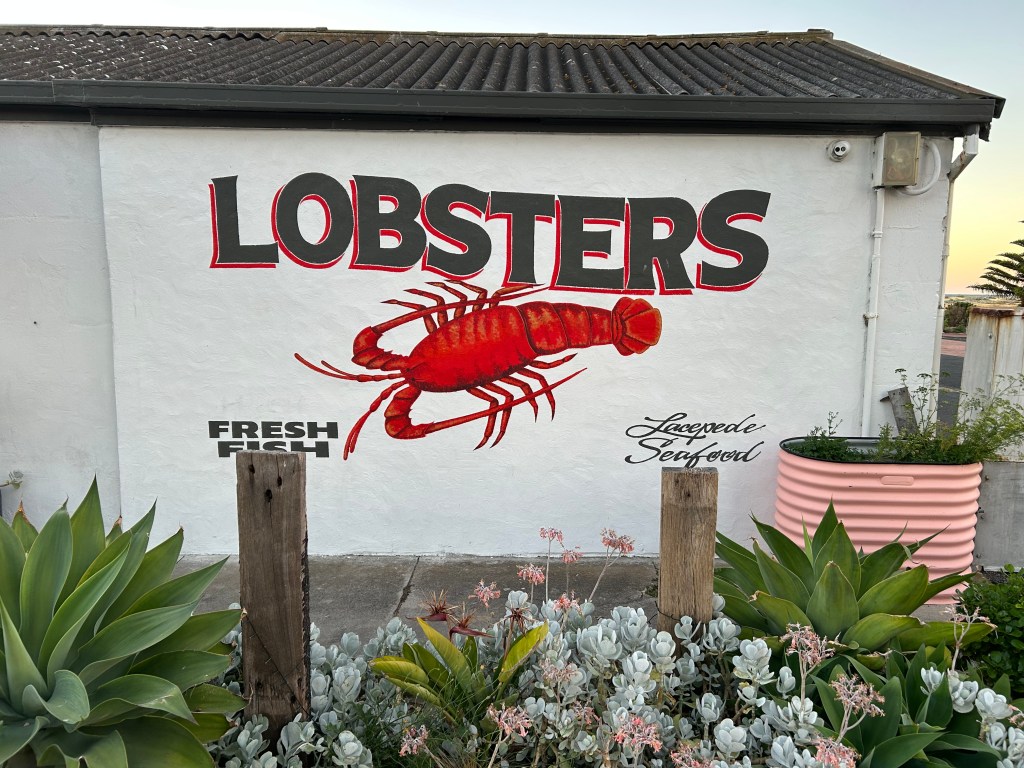
The shipwreck coast was well named. This lead us back onto the rest of the southern ports highway and we found our camping spot in Kingston beside their jetty and renowned fish and chips shop. We were hungry and looking forward to the lobster roll or the fish and chips, but the kitchen was closed when we arrived. They were sold out of the local lobster until 10 am the next day. These lobsters ranged in size from .5kg to 2kg and at $130/kg. We were a bit relieved there were none to tempt us as it was well above our budget. We bought some fresh Gummy Shark to cook for dinner as it is a popular local fish, and we had not tasted it yet. After a cheese and cracker lunch, we headed out on a walk around the river and estuary to find Larry the Lobster.

Fried in brown butter, we found that the Gummy Shark was bland and a bit soft like skate wing. Interesting but would not search it out. The Flathead from the last fish market was more memorable.


The local campers we spoke to looking for recommendations suggested stopping in Hahndorf, a German hamlet outside of McLaren Vale, and a trip to the zoo. My response on the zoo was that we were already there with koalas, kangaroos, wallabies, echidnae, parrots of all colours and sounds, and the lot.
Leaving Kingston meant we were only 4 more camping nights before we returned the Lizard King to the drop off in Adelaide. We bought a couple of fresh meat pies at the bakery across from Larry and headed along the Coorong National Park. This long stretch of park has a 200 km sand beach with an important wetland for migratory and endangered birds behind its dunes. Two primitive campgrounds are offered, and an avid birder would be thrilled. Driving through we could only think about Shiraz. Next stop was Hahndorf. Not far from a more obscure wine region called the Southern Fleurieu, it’s tree lined streets with old stone buildings boasting Bratwurst, Schnitzel and Ehrdinger beer. Too little time to give this area a proper look so, move on. We had lunch consisting of the ever present snack/ fast food called “pies” our unfortunate choices this time may or may not have contained meat in the pies. We moved on to Pink Gum campground in the Onkaparinga National Park. Within the forest and a river gorge to one side, it is surrounded by the massive wine production of the McLaren Vale appellation. In fact, there was an estate and cellar door across the road from the park. We arrived at a full sun site and a 37 degree forecast. Some trees nearby were shading the area, but we were warned that in summer when there has been no rain the large “pink gum” eucalyptus randomly drop huge branches without warning. We were warned and as we looked around there was evidence of trees doing just that!!

It was early when we arrived so we had time for a winery and a trip into the town of McLaren Vale for gas. First stop Coriole Estate. They were setting up for a wedding, but the cellar door was open. Two flights on offer, one at $15 and the other at $25. Fees waved on purchase of a wine. We chose to have one of each and see how it settled out. First taste was a Prosecco. Made in the northern Italian style it was dry, crispy apple, delicious. Then on to the rest. First stop Languedoc. Where were we?? The charming wine staffer was full of stories of the winemaker and generations of owners staying true to their European roots. And hers!! These white wines were killer. Reds too. We finished our tastings with a $120 estate shiraz that wasn’t coming home with us but made our eyes roll back in our heads. We successfully purchased an already chilled bottle of their Prosecco for $27A, which waived the tasting fees. Dinner from our two burner cooktop was orange chipotle glazed chicken with root veg risotto and pan roasted broccoli. With the prosecco, we were well wined and dined. After dinner a walk through the sunset light to the river trail. Only spotted one kangaroo, one wallaby and a big tree surrounded by fallen limbs. Next morning we smelled smoke and could see the wisps of smoke in the sky. Bushfire season. Might as well enjoy the full experience of summer in Australia before we go. It was 35 degrees C.


Next day we were off to Hugh Hamilton wines. Back in about 2008 we were invited to a cellar opening event and wine dinner at Bear Mountain Resort featuring their wines. Hugh Hamilton, a 5th generation vintner, explained the wines and afterward was gracious enough to chat a bit with us. Albert remembered and had the foresight to book a tasting. The winery is now operated by Mary, Hugh’s daughter. Hugh joked about being the black sheep of the family and has successfully marketed their wines accordingly.

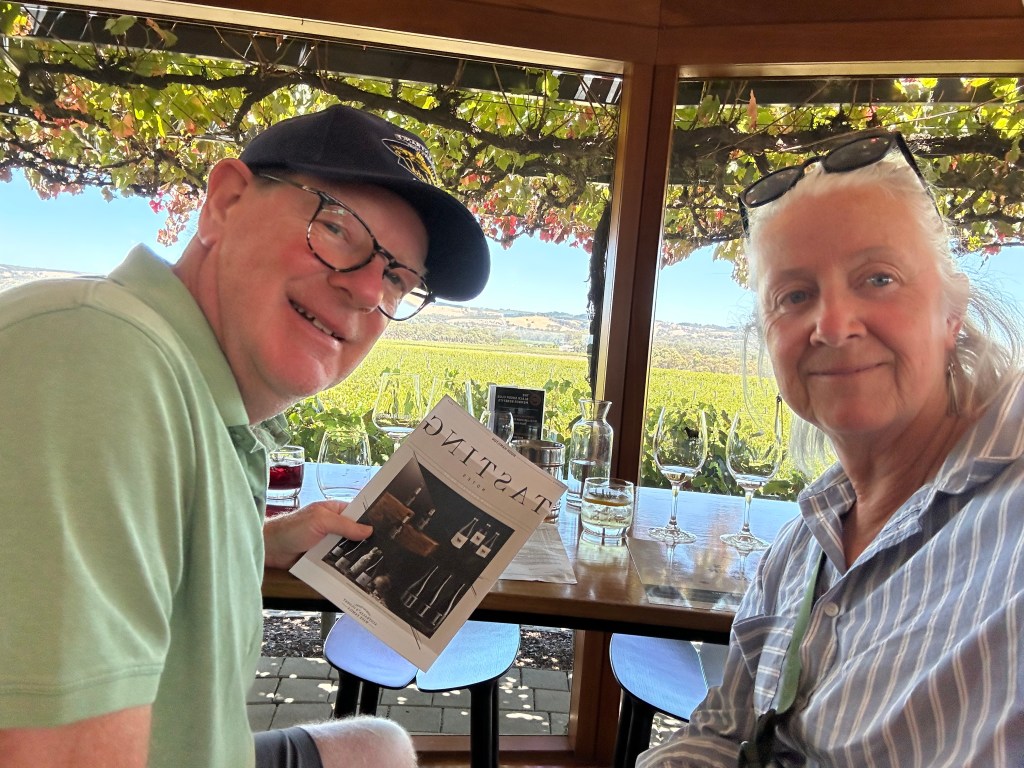

We tasted some fab wines but the most interesting for us was the list of Saperavi wines. Saperavi is a grape that hails from Georgia. It predates most wine making dating back to 6000BC.


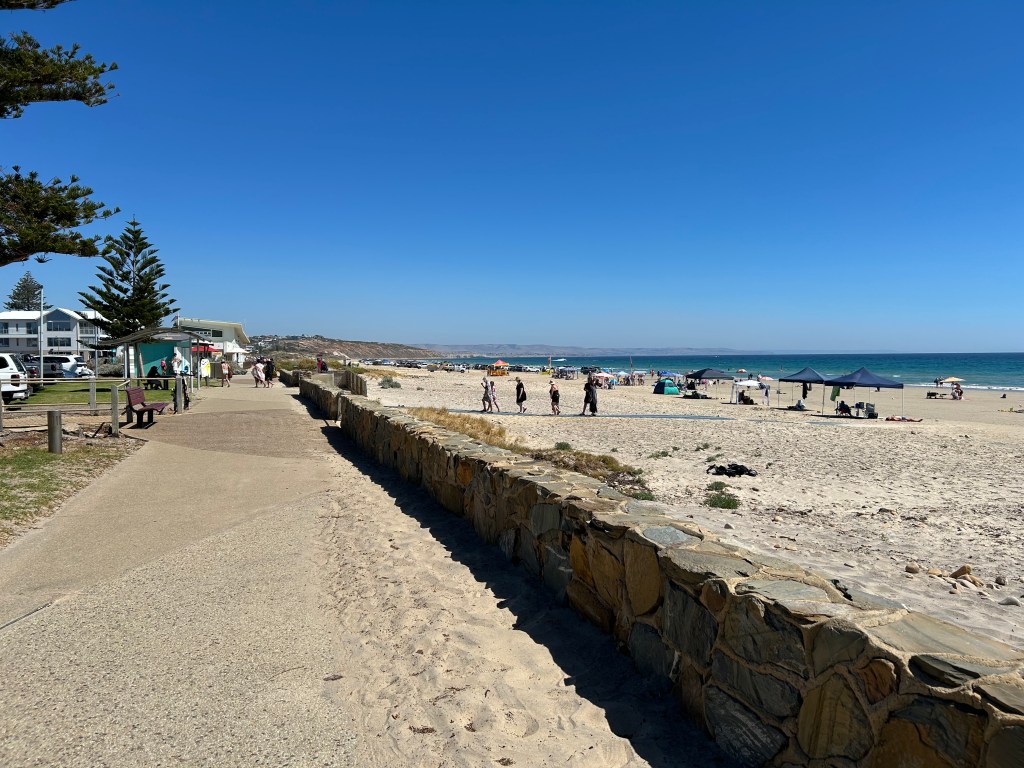
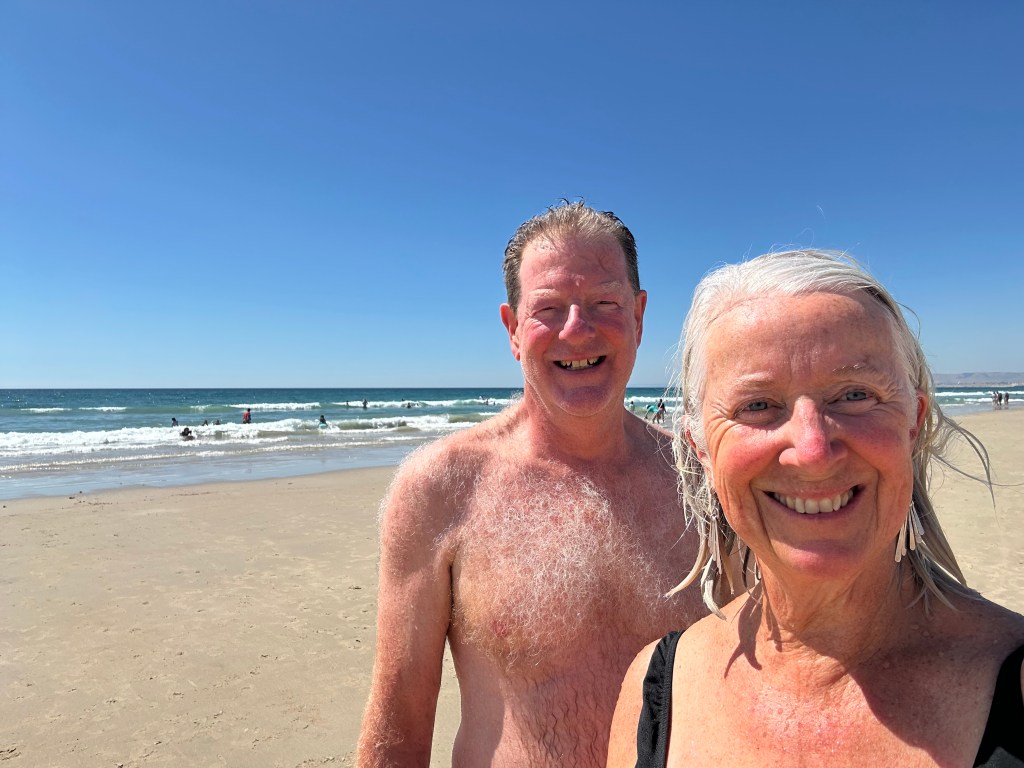
Our tasting took the better part of 3 hours talking with our wine steward Kath and eventually she convinced us to hit the beach 10 minutes away. Moana Beach did not disappoint. We were not brave enough to park on the sand beach like many others. But we sure loved the swim and shower afterwards!!
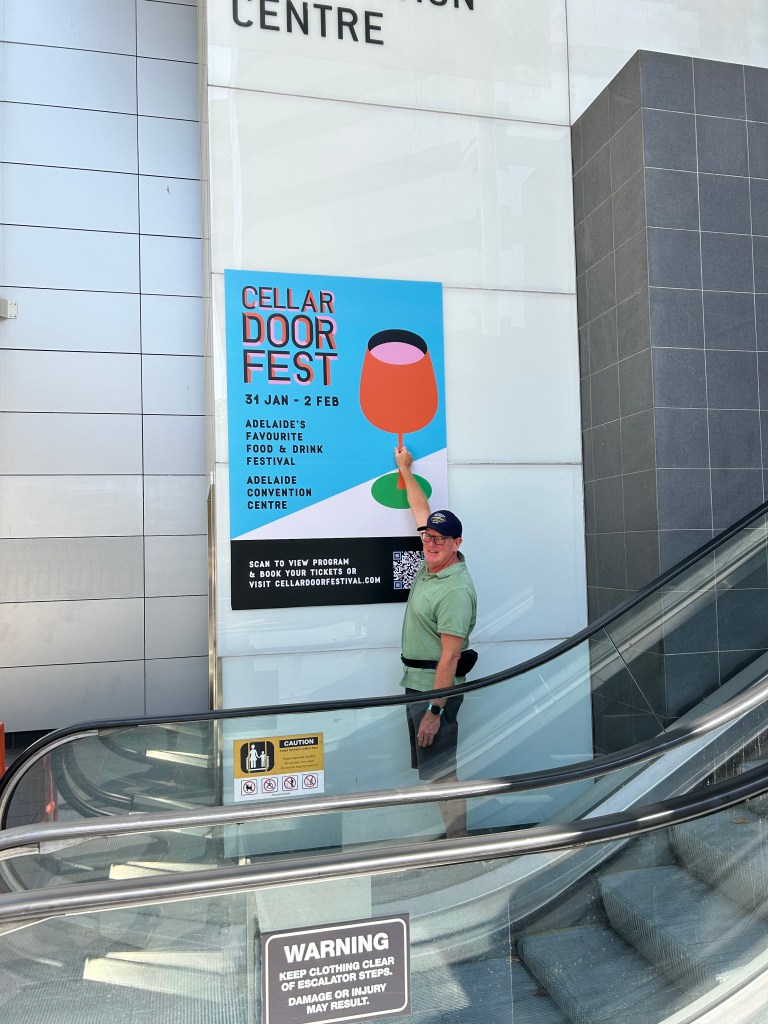
Another fantastic recommendation was to take the airconditioned train to Adelaide for the Cellar Door festival rather than driving 3 hours return to Barossa Valley. The festival featured vintners from all the wine regions of Southern Australia.
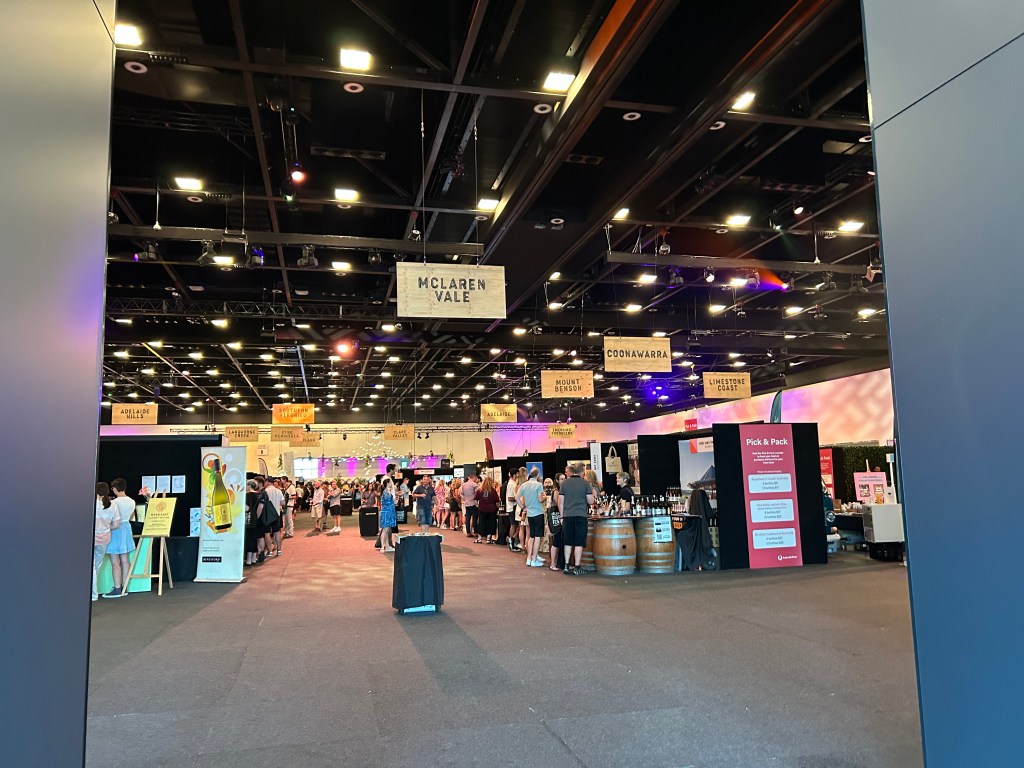
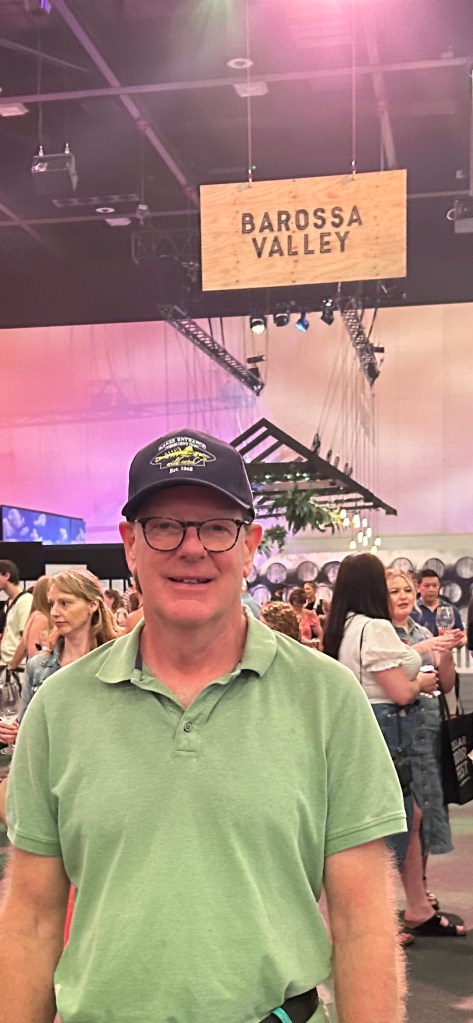
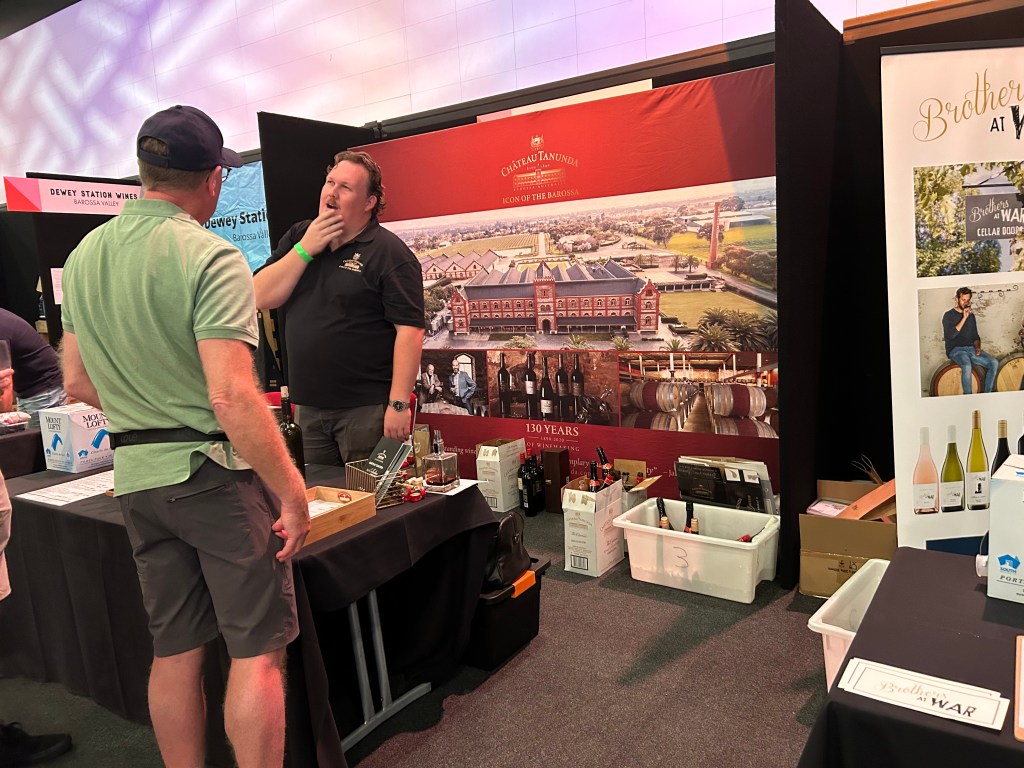

On our third full day in the McLaren Vale region we decided to hit the beach and find a beer. Sacrilegious or what but hey it was 40 C!! We had to get our laundry done and clean out the camper to return it the next day. Down day. Needed.
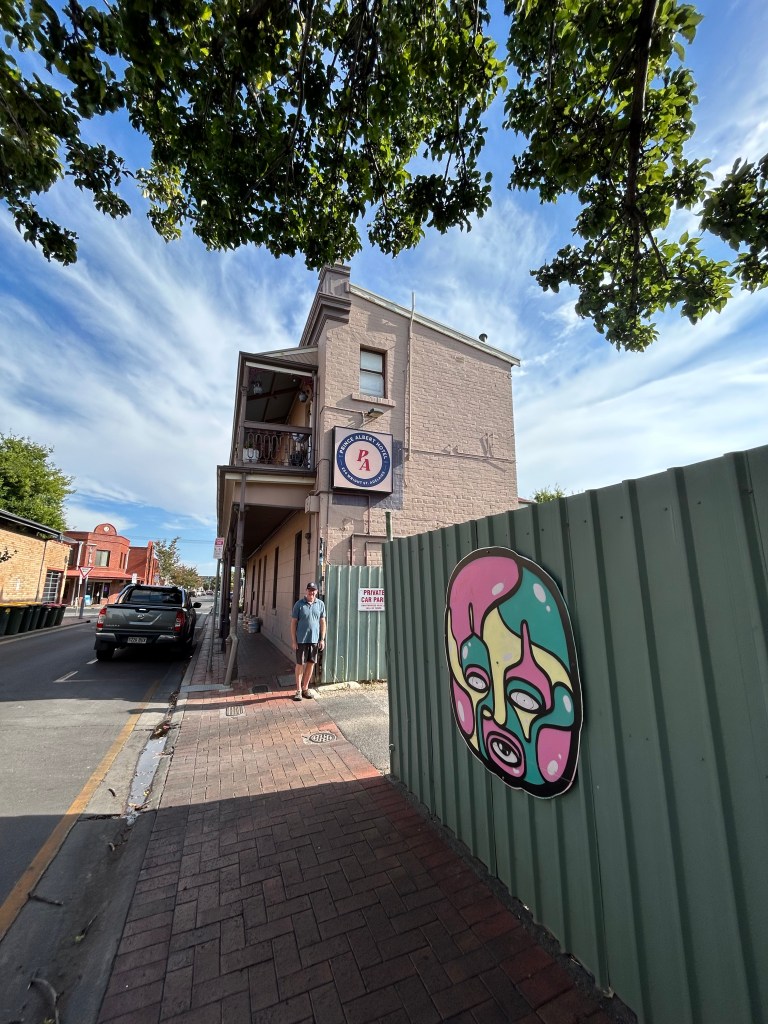
Once camper was returned we transited to our hotel and hit the Adelaide streets to find a nice gastropub with a cold beer and some good grub. Prince Albert Hotel won the best reviews. Tuesday is wing night and if you flip a coin and win you get the wings for free. Al was lucky!!


Today is our last day in Australia. Thank You to all the great Aussies that chatted, joked and provided awesome insights to the many fascinating places we explored. As a Commonwealth Nation we share many social and cultural attributes that make it so easy to navigate this extraordinary continent. If all you have travelled to is North America and the EU than consider this remarkable “feels like home” place. The people, the Koalas, the beaches, the cities are all worth your holiday time and money priority list. We had a Fantastic time and may be back one day.
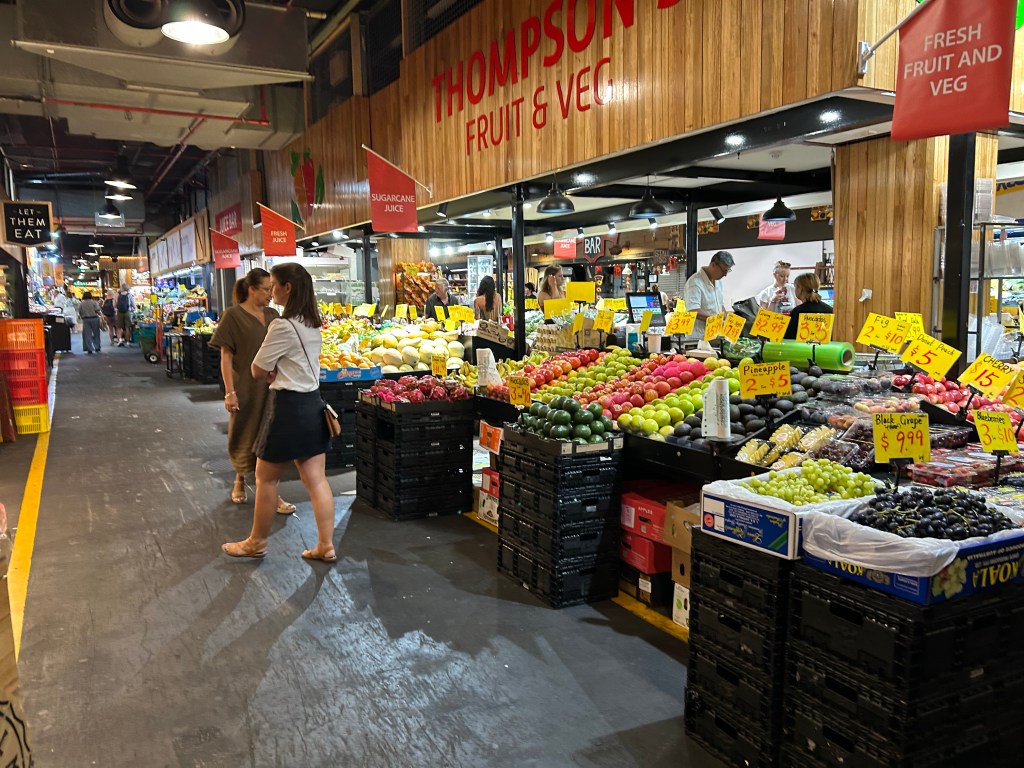
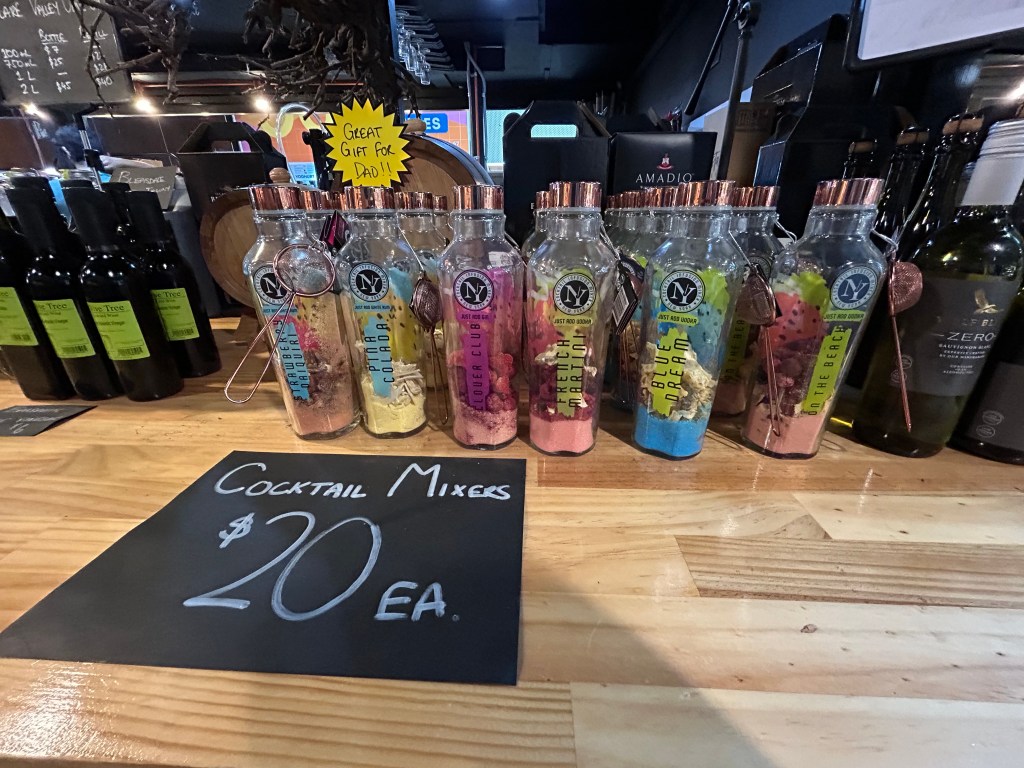
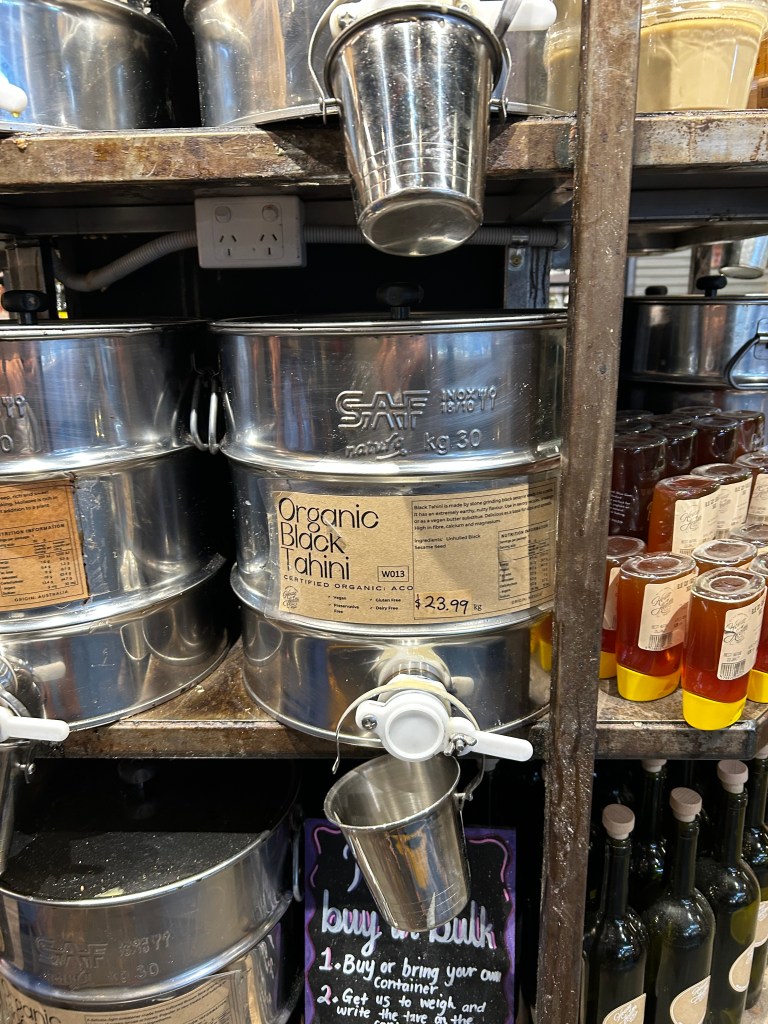
Adelaide has a huge central market (maybe the largest we have ever visited) with everything from fresh produce, fish and meat to a Pastel de Nata shop to a health food store flogging black sesame tahini and fresh squeezed cane sugar juice. So much so little time.

Tomorrow we fly to Bangkok.
 The Grape Escape